What’s the Good News and What’s the Bad News? Narrative Ethics, Part Three

The ruins of Dresden in 1945, facing south from the town hall (“Rathaus”) tower with the statue „Güte“ (“Good” or “Kindnes”) in the foreground, Deutsche Fotothek.

Introduction

This is the third in a series of posts about ‘narrative ethics’ in history education. The first and second posts in the series can be found here and here.

This and the posts that follow in this series focus on aspects of the work of Kurt Vonnegut (1922-2007), an American novelist and an exponent of historiographic metafiction.

Vonnegut was an infantry scout in World War II and was captured, shortly after being first deployed, in the Battle of the Bulge. As a prisoner of war he experienced the British and American bombing of Dresden. He survived the firestorm, ironically, because he was accommodated in a slaughterhouse, which had a particularly deep cellar designed to keep animal carcases cool. He was subsequently involved in the clean-up of the bomb dammage and the disposal of the bodies of victims – an activity that he mordantly described as corpse-mining (Mother Night, 1966, page viii)
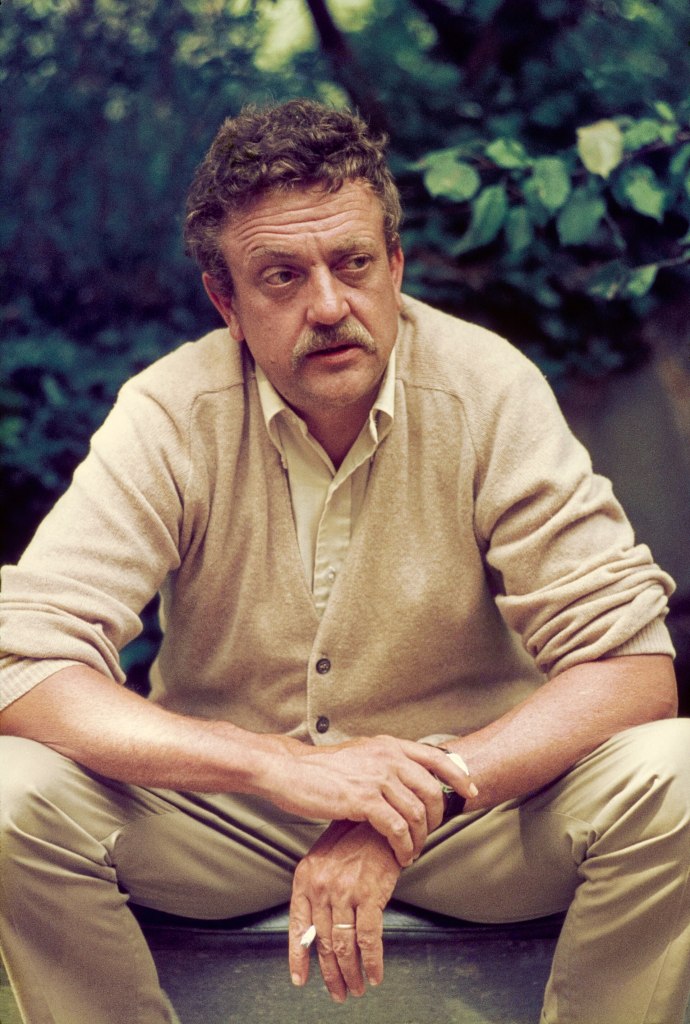
Being saved by sheltering in a slaughterhouse is, of course, a deeply ironic circumstance – killing, not saving, is what a slaughterhouse is for. Unsurprisingly, Vonnegut was a deeply ironic writer. Although he writes about the past in Slaughterhouse 5, he does so metafictionally, foregrounding and questioning the means available to a writer for representing reality and atrocity.

Although he diminished the impact of his experiences in Dresden on his writing career, the bombing of Dresden was the focus for his most famous and most successful novel, Slaughterhouse 5 (1969), and it shaped aspects of his other novels (notably Mother Night, 1966). He returned to the topic of Dresden again and again throughout his career, and his experiences undoubtedly played a role in shaping his broader anti-war outlook, expressed, for example in his last book, A Man Without a Country: A Memoir of Life in George W. Bush’s America (2005). It has been suggested – altough one might be sceptical of psychological explanations for textual phenomena – that his style of narration and the substance of the fictional worlds that Vonnegut created suggest he suffered from PTSD as a result of his wartime experiences.

Vonnegut’s reflections, in Slaughterhouse 5, on the dangers of stories that can make our heads ‘echo with balderdash’ (Vonnegut, 1965: 55) and give warrant to actions that cause massacres, will be the subject of the next blog in this series. I am going to focus, here, on Vonnegut’s work on the ‘shape of stories’ and on his questioning of what he saw as the simplistic and delusional story-patterns underlying much of ‘our’ narrative tradition. This aspect of Vonnegut’s work centres on the sceptical interrogation of plot and emplotment, something I interpret as aligning with work on narrative templates (discussed in the previous blog in this series).

My contention, here, is that cultivating reflection on emplotment, so that students become sensitive to and aware of how it can be used and abused in history-stories, is likely to be a useful activity for history educators to engage in; and that a disposition of incredulity towards certain types of narrative (to borrow a phrase of Jean-François Lyotard‘s from The Postmodern Condition) is something that history education should seek to develop in students.

Narrative Templates and the Shapes of Stories
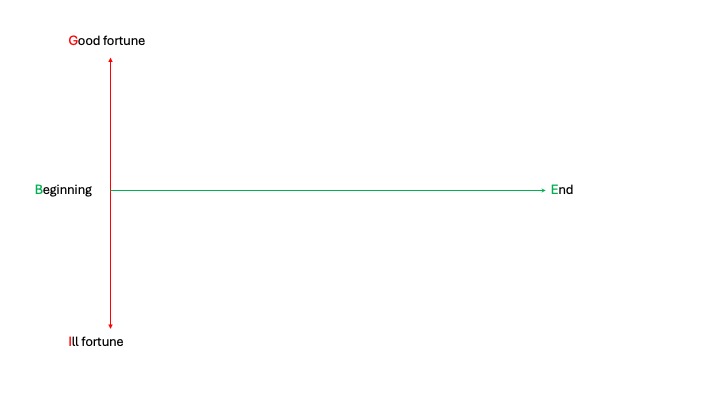
Vonnegut’s narrative template – blank (after Vonnegut, 1981 and 2005)

Although Vonnegut was a prolific author of novels, short stories, plays and commencement addresses, he wasn’t much of a finisher where academic study was concerned. He started, but never finished, a science degree and Cornell before enlisting as an infantry private in January 1943, and he struggled to finish his Master’s degree in Anthropology at the University of Chicago after World War II – a course of study he followed after demobilisation in 1945, benefitting from a GI Bill scholarship. He submitted and had his dissertation rejected in 1947 and then, again, in 1965, before Chicago awarded him an honorary degree, accepting his novel Cat’s Cradle (1963) as a thesis in 1971.

The version of his thesis rejected in 1965, entitled Fluctuations Between Good and Ill Fortune in Simple Tales, was put to frequent subsequent use by Vonnegut, in his teaching at the University of Iowa ‘Writers Workshop’ in 1965/6 and 1966/7, and subsequently, in numerous talks, many of which are now available online and also in the largely autobiographical Palm Sunday (1981) and A Man Without A Country (2005).(1)

As is often the case with Vonnegut, it is hard to tell how seriously he wants us to take what he says – he usually presented his ideas about story with characteristic humour and self-deprecation. Sometimes, he presents his models as tools to help a hack-writer make money – ‘plots’ become ‘ways to keep readers reading’ (Vonnegut and McConnell, 2019: 202). At other times he presents his work on story as an anthropological inquiry for which ‘the shape of a given socieity’s stories is at least as interesting as the shape of its pots or spreadheads’ (Vonnegut, 1981: 312).

What he purports to be analysing shifts, also. In Palm Sunday, he describes himself as collecting and analysing ‘popular stories from fantastically various societies’ (1981: 312), but in ‘Here’s a Lesson in Creative Writing’ (Vonnegut, 2005: 23-45) he implies that these analyses only map the literature of limited range of cultures and that his focus is contemporary American popular literature (2).

The fundamental idea behind Vonnegut’s story schemata is ‘that stories have shapes which can be drawn on graph paper’ (Vonnegut, 1981: 312), usign a schema that posits a ‘G-I axis: good fortune – ill fortune,’ and a ‘B-E axis’ on which ‘B’ is for ‘beginning’ (Vonnegut, 2005: 15) and ‘E stands for end’ (Vonnegut, 1981: 313), as in the figures above and below. The top of the GI axis represents ‘great prosperity’ and ‘wonderful health,’ the bottom ‘death… terrible poverty’ and ‘sickness,’ and the middle (where the BE line sits) represents the ‘average state of affairs’ (Vonnegut, 2005: 25). As Vonnegut summarised things in 1981: ‘The late Nelson Rockerfeller, for example, would be very close to the top of the G-I scale on his wedding day. A shopping-bag lady waking up on a doorstep this morning would be somewhere nearer the middle, but not at the bottom, since the day is balmy and clear’ (Vonnegut, 1981: 313).

Graphing the fortunes of the entity whose story you are mapping over time (B-E) on the ‘good-ill fortune’ scale (G-I) gives you the shape of that entity’s story, in terms of improvement and decline against the relevant societal average over time.
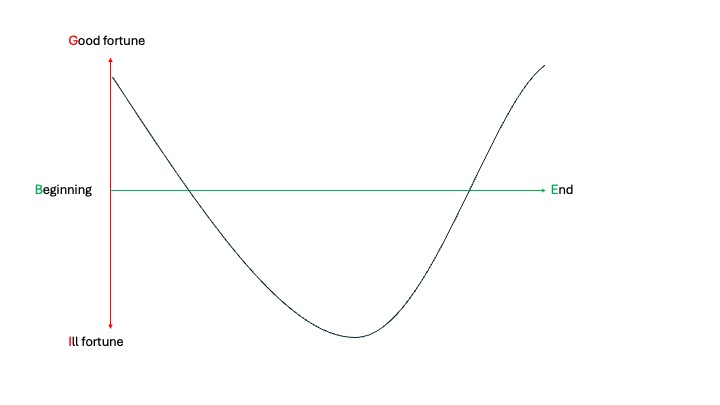
Vonnegut’s ‘Man in hole’ narrative template (after Vonnegut, 1981 and 2005)

Vonnegut’s 1965 dissertation listed 17 story shapes in an appendix, six are presented in Palm Sunday (1981) and five in A Man Without A Country (2005). Maya Ailam has created 8 remarkable graphics that interpret Vonnegut’s shapes (available here).

The diagram above replicates what Vonnegut calls the ‘man in a hole’ schema. For the man, things begin well but this equilibrium is disrupted by events that dramatically worsen his position until he reaches the bottom of the ‘hole’ into which ill-fortune has pitched him. The man does not give-up, however, but, through a struggle against outrageous fortune, he opposes and overcomes his troubles and climbs back out of the whole, returning to the position he started in, or to a position slightly better than his starting position.

In addition to the ‘man in hole’ schema, Vonnegut discusses a number of other schemata, including ‘boy meets girl,’ ‘Cinderella,’ and ‘Kafka’ (Vonnegut 1981: 312-315).

Applications in History Education and Historical Theory
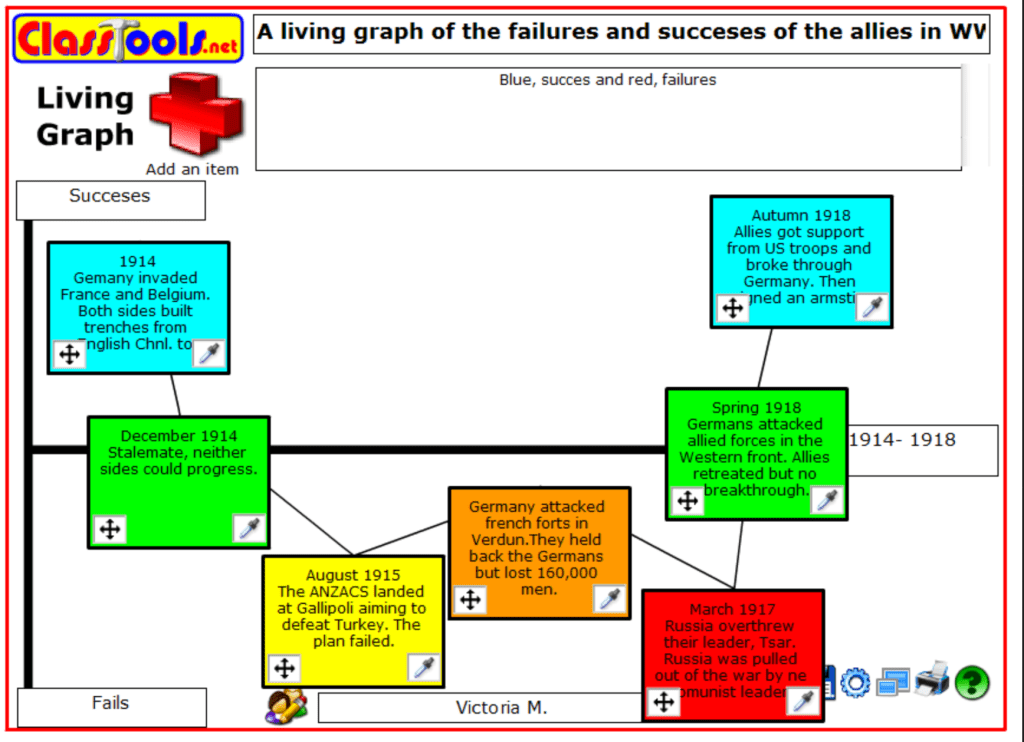
A living graph posted by Learning@Loreto (March, 2014)

Vonnegut’s modelling of the shapes of stories seems to me to provide a clear visual representation of various narrative patterns or plot shapes, and to have a number of potential uses in history education. They might be used, for example, to provide a clear visual representation of the schematic narrative templates that Wertsch talks about (discussed in the previous post in this series) and to visually represent what Wertsch calls ‘specific stories’ (the narrative of a particular course of events). They could also be used to represent stories at a range of scales intermediate between those two extremes.

In fact, it seems pretty clear that they are already used in history education (as it were) in the form of ‘living graphs’ (discussed here at pps. 188/9), as is illustrated in the figure above, which has the same form as Vonnegut’s examples, and the figure below, which moves the vertical axis to the middle and which has a more precise analytical focus than a simple ‘good’ and ‘ill’ fortune focus that Vonnegut discusses. Clearly, the wheel can be invented at least twice.
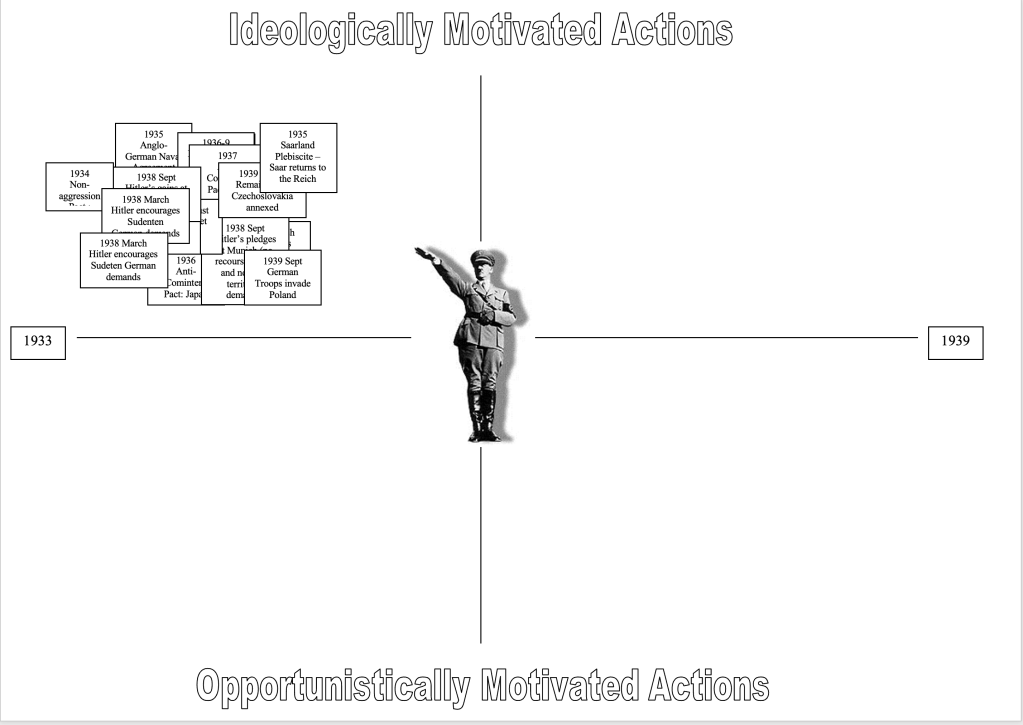
A living graph students can use to model change over time in the character of Hitler’s foreign policy, 1933-39, dragging & dropping events chronologically on a horizontal axis and analytical on a vertical axis (Chapman, 2004).

The key point to note about Vonnegut’s story shapes is that, at least by 2004/5, he did not consider such plots ‘accurate representations of life’ but, rather, rhetorical devices to manipulate interest and attention, and to align with the expectations, of story-consumers. His contention is, first, that most of the stories in the Western narrative tradition trade in crude simplifications, and, second, that these simplifications are mis-leading.

Vonnegut’s Critique of Story Shapes

In elaborating his ‘shapes of stories’ Vonnegut was, I think, developing tools that lend themselves very readily to the work of what I’m calling narrative ethics. They are presented as devices to help us understand how stories work, and, therefore, how the storied-world in which we live works. Ought implies can, it has been said, and understanding how the world works is a precondition for acting in it effectively, for good or ill.

I think Vonnegut’s schemata have at least two other uses also, relating to ethical reflection on historical sense-making.(3)

First, these schemata draw attention to the evaluative work that is involved in all story telling. Up and down fluctuations are only possible if we have a clear axis and index on which we are measuring ‘rise’ and ‘fall’. Any notion of narrative development is normative, in some degree or other, if by development we mean anything more than simply ‘change.’ In drawing attention to the evaluative axis of stories, Vonnegut opens-up scope to interrogate and reflexively question those evaluations, a move we can follow and, perhaps, aim to open-up in our teaching, so as to encourage history students to become reflexive and critical thinkers about story.

Second, a line that rises and falls raises questions of it’s own. It implies stability of identity over time – it traces something through its ups and downs and, thus, posits a minumal core continuity in identity. How credible is that assumption, for example, in ‘national’ histories that posit ‘continuous’ national history over milennia, as the first ‘aim’ of the current English National Curriculum for History does? Furthermore, one might also ask questions about the singularity of focus that a single line of emplotment provides – is there really only one story that can and should be told? Whose story might that be? Who has the right to tell it, and what responsibilities arise from the activity of telling? If there is more than one story that could be told, who (if anyone) might have the right to chose which stories get prioritised and which marginalised or, even, erased?

Narration and Evaluation: surfacing narrative normativity

Hamlet, Horatio, Marcellus and the Ghost, Henry Fuseli (no date)

Vonnegut described himself as a ‘hack’ prior to the writing of Slaughterhouse 5 (Vonnegut, 2005: 18). He suggests that one of the reasons he wasn’t able to write his Dresden story in the years between his return home in 1945 and his final success in writing it 1968/9 was that he had been trying to write a story that conforrmed to false conventional expectations. He had been trying to tell the kind of Hollywood story in which ‘Dean Martin and Frank Sinatra and the others would play us’ (Vonnegut, 2005: 18). In effect, he could only write his Dresden book when he stopped trying to ‘hack’ it, abandoned the standard writerly tricks, and responded to Mary O’Hare’s request (discussed further in the post that follows this one) to ‘tell the truth for a change’ (Vonnegut, 2005: 19).

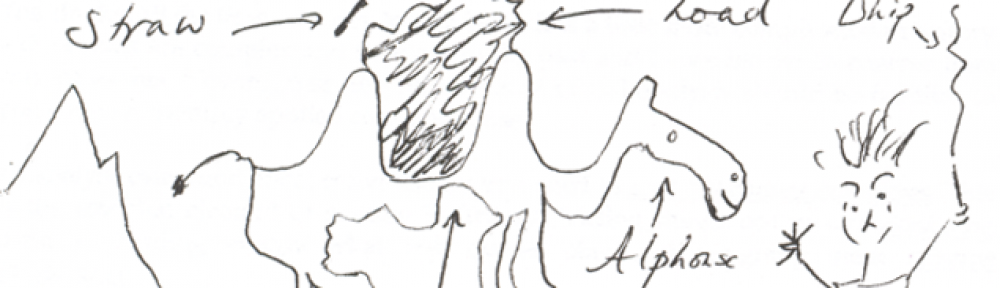
He talks, at one point in Slaughterhouse 5, about trying to apply his own story-graphing techniques in planning the story, and, I think, dramatises their failure.
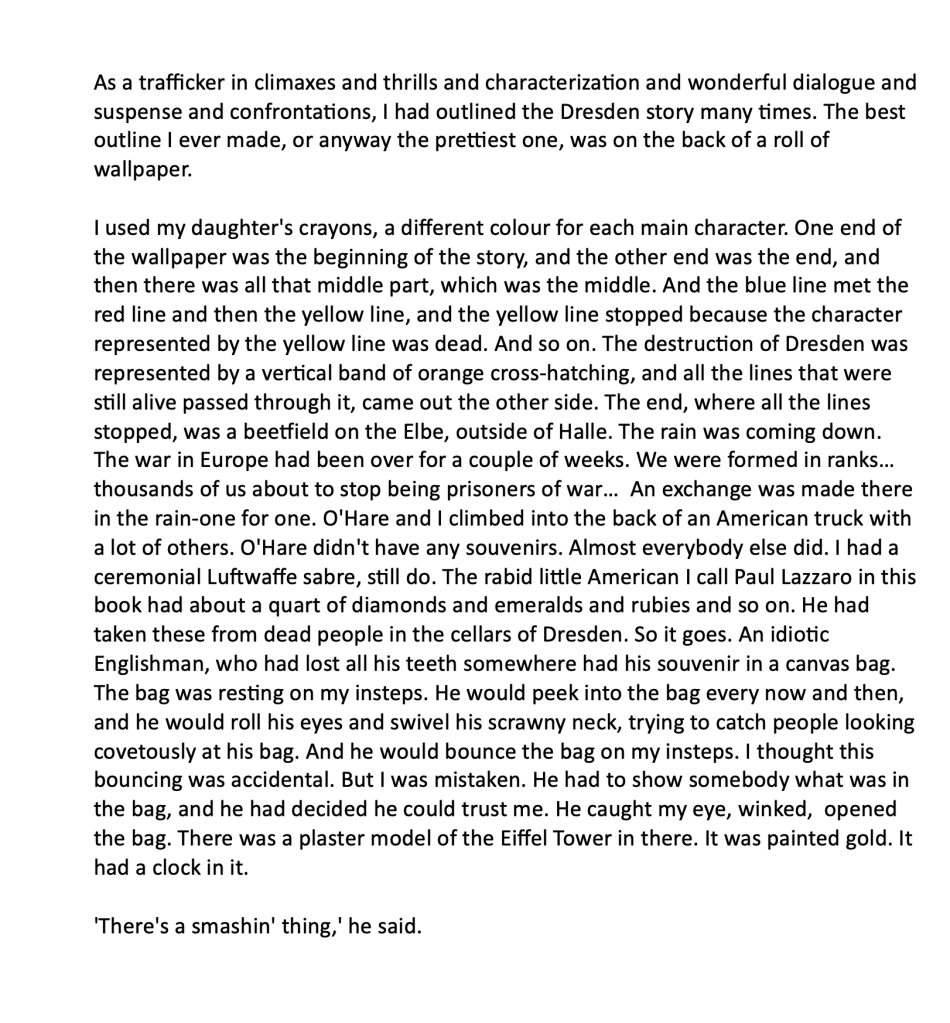
Vonnegut, Slaughterhouse 5, 1969: 4-5.

The passage juxtaposes climax-generating story-plotting techniques with the entirely anticlimactic absurdity of a gold-painted plaster Eiffel Tower with a clock in it. After the hecatombs of Dresden, the firestorms and the ‘corpse-mining,’ represented by orange cross-hatching on his story schema, we come to an incongruous narrative non-sequeter: ‘an idiotic Englishman’ covertly hiding-sharing his garish model Eiffel Tower.

In his later ‘shape of story’ lecturers (in the 2004 lecture recording but not in the undated earlier version) and in his later write-ups of his insights (Vonnegut 2005 versus 1981), Vonnegut brings Hamlet into the picture. The point that he uses Hamlet to make is that in real art, rather than popular story-telling of the kind he had made a living from as a ‘hack,’ simple narrative patterns don’t work, because one of the things that art does is problematicise, rather than enact, simple evaluative schemes. In A Man Without A Country (2005), the Hamlet story schema diagram is, in effect, a schema without a narrative line, since it isn’t clear, as the story unfolds, whether a development in the story is ‘good news’ or ‘bad news.’ In other words: ‘Shakespeare told us the truth… The truth is, we know so little about life, we don’t really know what the good news is and what the bad news is’ (2005: 37).

A still image from Slaughterhouse 5, the movie, 1972.

Billy Pilgrim (on the left in the image above), the largely fictional protagnonist of Slaughterhouse 5, is a passive anti-hero. He is without obvious character motivation. There is no ‘object’ that he ‘lacks’ and ‘seeks,’ of the kind that figure in work of narrative theory, such as Propp’s Morphology of the Folktale. He is not involved in any clear narrative drama or conflict – the agon that is needed to pitch pro- and ant-agonist against each other is entirely absent. He seems to almost entirely lack will and intention, also, and is content merely to enjoy ‘nice’ moments, and to enjoy them entirely as moments, without any driving narrative direction or expectation. He flits back and forth between moments, ‘unstuck in time’ (1969: 19) and, thus, free of any obvious narrative line.

As Tom Roston observes, in The Writer’s Crusade: Kurt Vonnetgut and The Many Lives of Slaughterhouse 5: ‘we can see that on Vonnegut’s fluctuations-in-ill-and-good-fortune chart, Pilgrim’s story has no curves. It starts very low and remains there all the way across. But it doesn’t feel that way reading the novel because Vonnegut shreds the sequences, reordering and connecting them with time-travelling threads’ (2021: 80). In his master work, then, Vonnegut very clearly tells us that it is an illusion to think that real stories have conventional shapes, and that we should be sceptical of the kinds of story that shape-up too easily, in nice perceptible plot lines, climaxes, and so on.
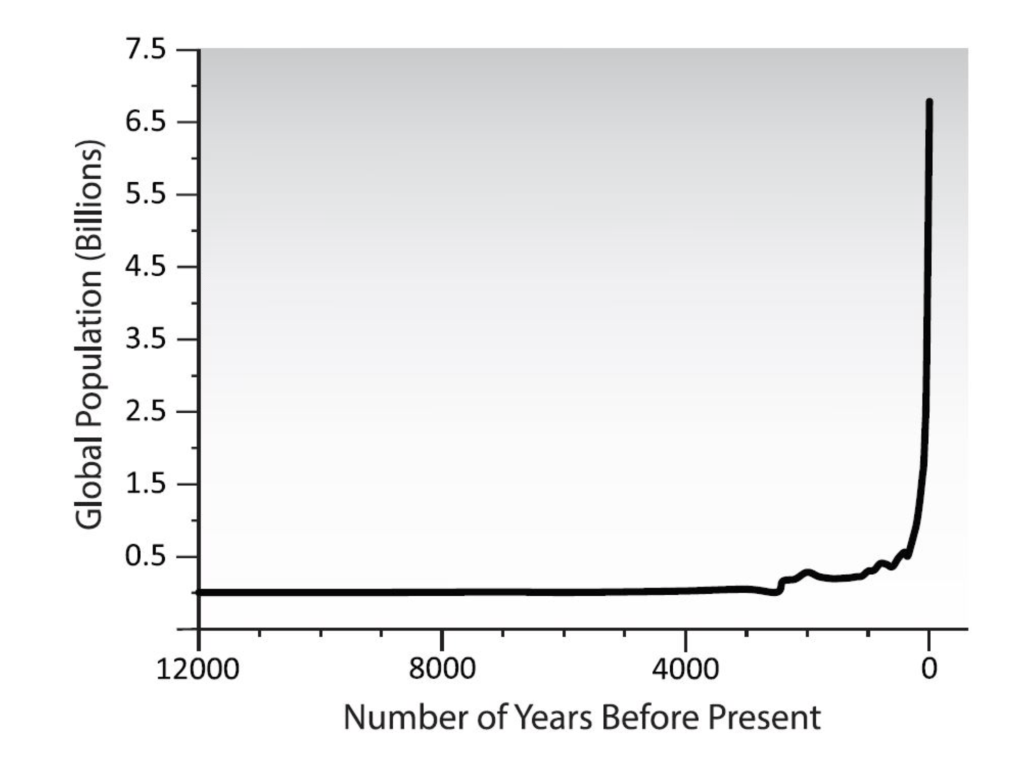
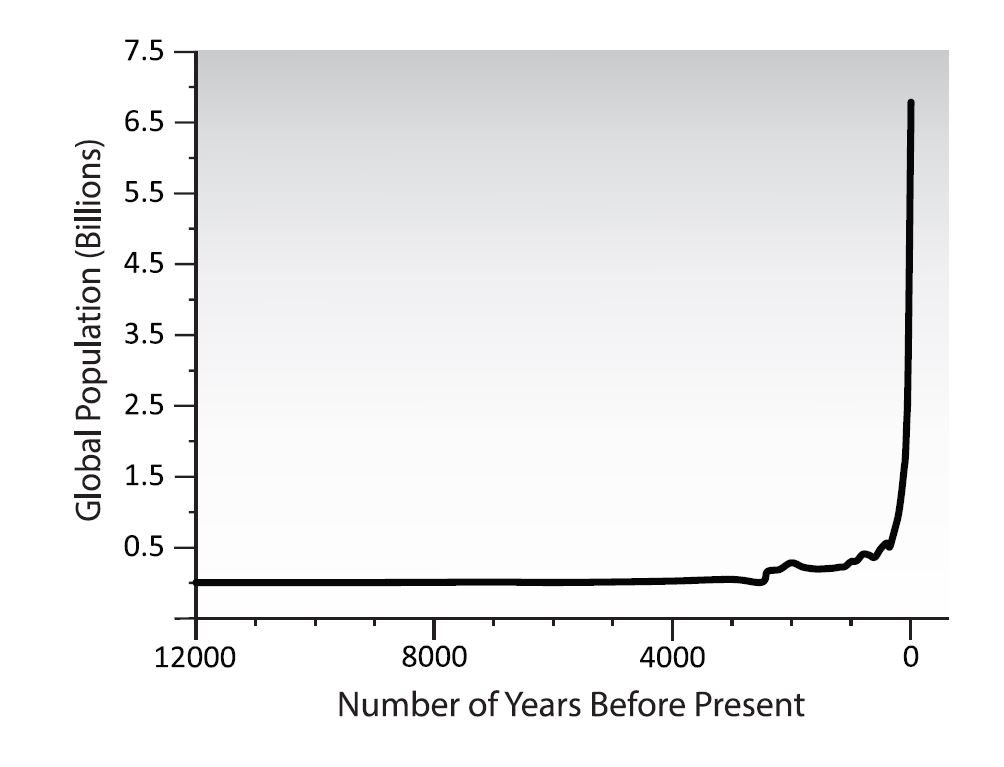
World population over the last 12,000 years

Whatever applies in Hamlet or Slaughterhouse 5, one might reply that none of this has application in history education where we can often be very clear about what we are trying to track over time, as in the world population graph above. It is true, of course, that the price of grain, the number of election riots, the reporting of violent assaults in Old Bailey Online, and innumerable other things, are questions where a graph can be unproblematically constructed – at least in principle, data-sets permitting. Nonetheless, as things like the debate on the ‘standard of living’ in the Industrial Revolution show, when evaluative judgments are involved – of the ‘This change is (or is not) an improvement’ kind – things get rather more complicated. Do we place more weight, in calculating standards of living, on food prices or on work-place autonomy, for example? Once we move beyond description, and into judgments, history inevitably becomes normative. And to handle normative judgments effectively, one has, first, to recognise them.

Toeing the Narrative Line: surfacing narrative exclusivity

To trace ‘rise and fall’ on a graph you have to have a line to follow – in other words, there must be a singular entity (‘Napoleon,’ ‘the Mensheviks,’ ‘the working class, ‘ and so on) whose fortunes you set out to trace and which itself remains stable, in at least some minimal sense, throughout the story. If ‘it’ is to have a ‘story’ unfolding in time, it must remain an ‘it’ for the duration of that unfolding.

Tracing the fortunes of such entities does at least two things, I think, that raise questions with ethical implications. First, the question ‘What do we see and what do we miss, if we focus excluively on X?’, and, second, the question ‘In what senses can we meaningfully claim that X remains the same entity over time?’

The first question takes us back to Brecht’s worker (discussed in the first blog in this series) and their objections to the kind of historical blindness that results from exclusive focus on the decisions and actions of one type of historical actor: ‘Caesar defeated the Gauls. Did he not even have a cook with him?’

Pieter Bruegel the Elder, Landscape with the Fall of Icarus, c. 1560, Royal Museums of Fine Arts of Belgium, Brussels.

Brecht’s worker does for history what Stoppard’s Rozencrantz and Guildenstern are Dead does for Hamlet, directing us to look at those the original narrator classified as bit-part players and supporting actors without a story line of their own worthy of attention, and directing us to frame a history around them instead of focusing on the canonical figure that story traditionally centres. This is also what both Bruegel’s Landscape with the Fall of Icarus, and Auden’s commentary on it in his ‘Musée des Beaux Arts,’ do, directing attention away from Icarus crashing into the sea, a central focus in Ovid’s narrative in The Metamorphoses, and directing attention towards a ploughman, for whom that crash ‘was not an important failure’ (Auden, 1938).

As has already been noted in earlier blogs in this series, a key task for historiography – as for history education – in our time is to recentre narratives away from erstwhile ‘subjects’ of history and to look at the slienced pasts of those who these historical ‘subjects’ subjected to various kinds of oppression, both in historical reality and in narrative historiography. This is work that scholars like Edward Thompson and Michel-Rolph Trouillot pioneered and that contemporary history educational projects, such as Project LETHE or the work of Justice 2 History, are addressing.

The questions that using continuous subject labels for histories raise are not, perhaps, so frequently explored. Perhaps they ought to be? The English National Curriculum, as has been noted, makes the somewhat extraordinary move, in its opening aim, of claiming that the islands presently at least partly in the United Kingdom have a singular continuous history – a claim that ignores the plural existence of the four nations that are currently contituent of the United Kingdom state and the fact that each have their own separate histories and their own separate history curricula.

What this points to, I think, is the role that histories can play in shaping, in enabling and in erasing identities. One imagines that the phrase ‘understand the history of these islands as a coherent, chronological narrative’ was authored by an English politician, as ignorant of the differentiated histories of these islands and their constituent nations as the then Prime Minister John Major showed himself to be, in 1992, when he spoke of ‘1000 years of British history,’ ignoring the fact that the Act of Union was signed in 1707.

That presentist assumptions should project current identities back into the past and forward into the future is probably unsurprising. However, if history education is good for anything, it should serve, minimally, to remind people that ‘what is’ has not ‘ever been so,’ and that what seems normal and permanent today can readily pass into history. ‘Heaven smiles,’ Shelley wrote, ‘and faiths and empires gleam, like wrecks of a dissolving dream.’

It is also possible, of course, for presentist assumptions about institutions to inform actions that actively seek to transform and reshape futures, so that past fluidities and hybridities are erased. Something like this seemed to have been proposed, in 2022, when the Conservative former Brexit Minister Lord Frost argued that the government should change the world by changing how it talked, and by prioritising statehood (the UK) over nationhood (England, Scotland, Wales and Northern Ireland): “Somehow we have all drifted into speaking as if this country were already a confederation made up of four ‘nations’ that have chosen to work together (but could equally choose differently)… But the UK is a unitary state, not a federation or a confederation. Both the 1707 and 1801 Acts of Union fused the participants into one state in which all were equal, first ‘Great Britain’, then the ‘United Kingdom’, with one sovereign legal personality and one Parliament and government… if you are a citizen of that unitary state, you are British.”

A useful task, for historical research and for history education, perhaps, is to keep the entities posited in histories that trade in long-term continuities under constant review. What changes and what remains the same over time in these entitites, and what role do present discourses and practices play in maintaining, or even in helping to manufacture, such continuities? What role should historical writing and history education play in seeking to maintain, or to change, the narrative underpinnings of the worlds we currently inhabit?

*****

Endnotes

(1) I first read about these ideas in a remarkable 2014 blog post on Open Culture featuring powerfully Vonnegut-illuminating infographics by Maya Eilam. Eilam has developed an important ‘Narrative Practice‘ project, using Vonnegut and other resources to explore the question ‘What happens when we tell stories differently?’.

(2) Vonnegut states that he found that his shapes did not apply to what he calls ‘primitive’ people’s stories – their stories were ‘dead level, like the B-E’ axis (2005: 29). This is problematic language, of course, and much of Vonnegut’s ‘humour’ is often problematic (something that I will return to in a later post). Vonnegut is, I think, aiming to be ironic, however, in using the term ‘primitive’ here. His analysis contrasts the stories of Shakespeare and the Arapaho, both of which, he says, don’t map onto simplistic story shapes, with the erroneous and simple stories that he discusses using these shapes (2005: 28-29 and 37). In other words, he seeks to show the ‘primitive’ stories are more sophisticated than the thinking of the cultures that coined self-boosting developmental hierarchies and evaluative pseudo-scientific terms like ‘primitive.’

(3) There is more to be said about the practical-pedagogic (rather than the narrative-ethical) uses of Vonnegut’s story-schemata. I will post a shorter practical note on here shortly.

References

Vonnegut, K. (2005) ‘Here’s a Lesson in Creative Writing,’ in A Man Without Country: A memoir of life in George W. Bush’s America. (2007 Edition). London: Bloomsbury, pp.23-37.

Vonnegut, K. (2004) ‘Shape of Stories’ lecture, February 4th 2004. YouTube.

Vonnegut, K. (1981) Palm Sunday: An autobiograpical collage. 2021 Vintage Edition). London: Vintage.

Vonnegut, K. (1969) Slaughterhouse 5 or the Children’s Crusade: A duty dance with death. 1991 Vintage Edition. London: Vintage.

Vonnegut, K. (no date) ‘Shape of Stories’ lecture. YouTube.

Vonnegut, K. and McConnell, S. (2019) Pity The Reader: On Writing With Style. New York: Seven Stories Press, pp.201-215.
Schemata, Prototypes and Templates: Narrative Ethics, Part Two

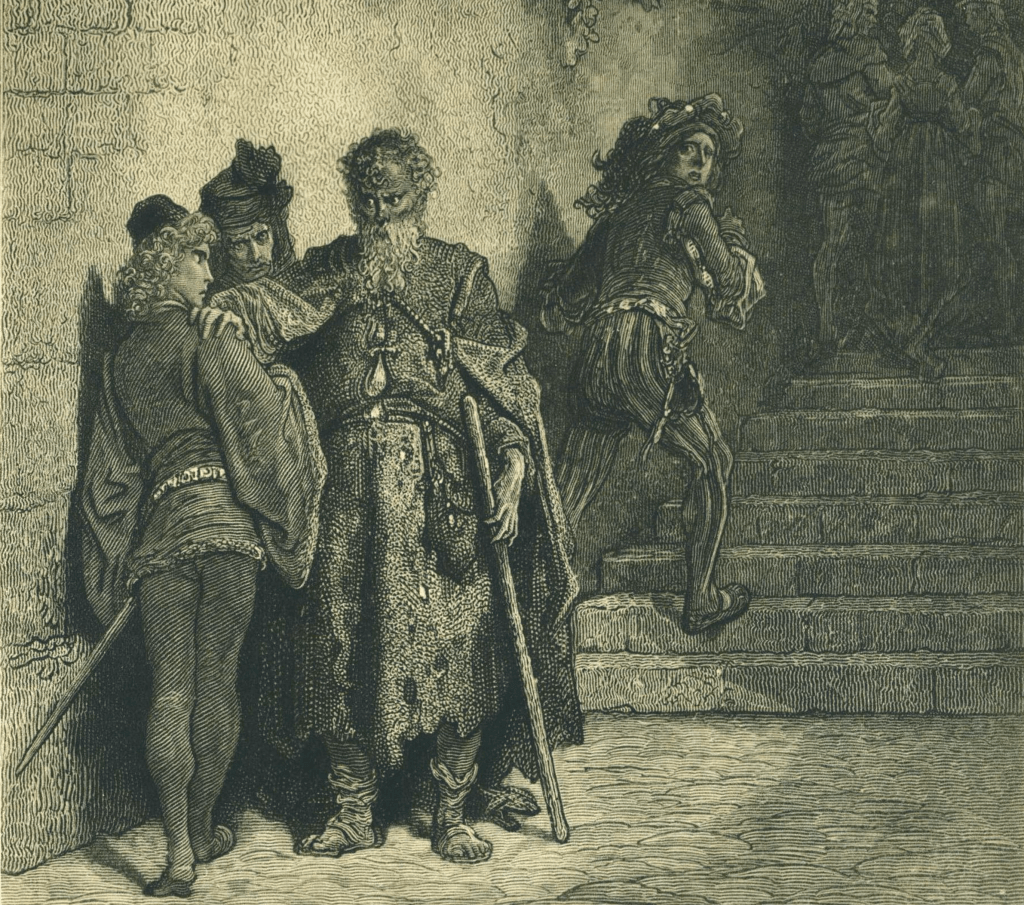
Gustav Doré, The Rime of the Ancient Mariner (detail), 1866 (from the 1925 German edition)

Introduction

This is the second in a series of posts about ‘narrative ethics’ in history education. The first post in the series can be found here.

This post is concerned, largely, with laying the ground-work for a discussion of Kurt Vonnegut’s work on the shape of stories in the third blog in this series. This post aims to set-up some concepts from schema theory.

Like many of my colleagues in history education in England, I am an amateur and a magpie of schema theory rather than an expert exponent of it. All I do here is bring together some ideas that I’ve found interesting and that, it seems to me, might be useful to history educators.

These ideas seem to converge to a degree – specifically, aspects of the work of David Bordwell and James Wertsch – and also to take us beyond the somewhat undifferentiated ways in which schema have often been discussed in history education in England in the last ten years or so, often drawing on Chapter 2 of Hirsch’s Cultural Literacy, 1987.

I am sure that there’s much more to say than I manage to say here: this is just a start.

Constructing Story: Assumption Prediction, Confirmation, Revision

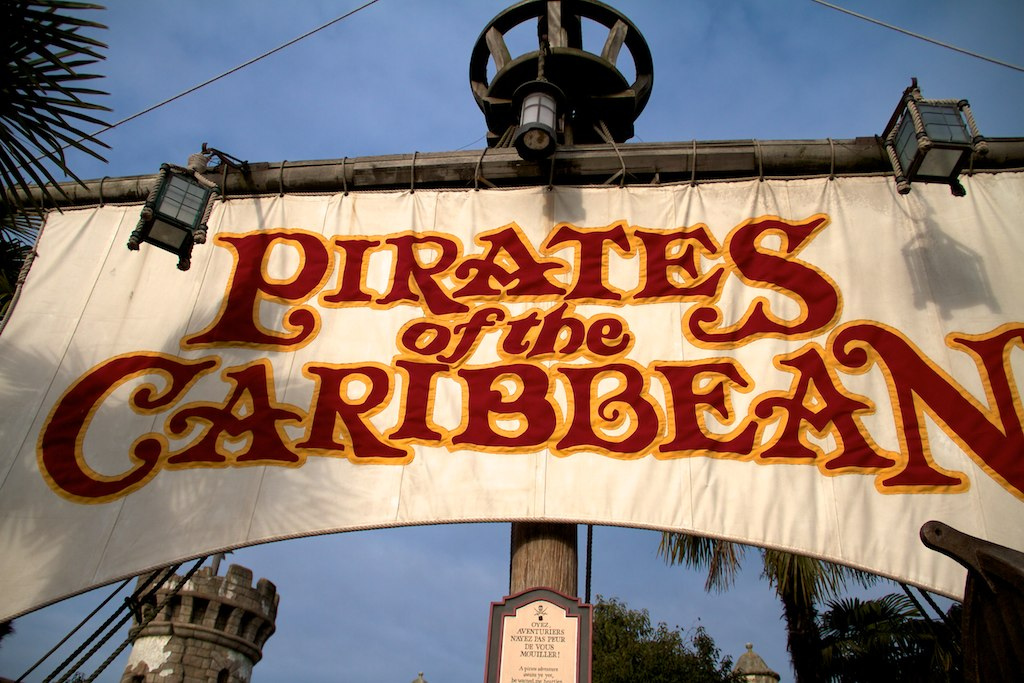
The Pirates of the Caribbean Disenyland ride, Eric Riltchey, 2011.

Cognitive scientific explanations of narrative comprehension, David Bordwell has argued in various places (Bordwell, 1985 & 2009), can fruitfully make use of the notions of schemata and of prediction to make sense of how we interpret or construct stories.

We interpret incoming data (in a film, text, sound or other narrative context), the story goes, by forming hypotheses about the larger patterns that these data are part of, and these hypotheses are then confirmed or revised, as we continue to make sense of new data and as the narrative continues to unfold.

The hypotheses story-consumers make could include the hypothesis that we are experiencing a story (rather than just random unnconnected data). They could include the hypothesis that the story we are experiencing is a story of a particular type (e.g., a pirate story). They could include the hyptheses that X is the pro- (e.g., Little Red Riding Hood) and that Y is the antagonist (e.g., the Wolf) in the story. They could also include the hypothesis that the events we are viewing constitute a larger whole (e.g., a chase sequence), and the hypothesis that this chase is part of a larger story sequence (e.g., a quest narrative). And so on, and so on.

On this model, the consumer of stories co-constructs the narrative they are experiening by forming hypotheses about what is going on and by bringing together and organising the narrative data presented to them (in a book, film, conversation over coffee, etc.). They are co-constructing because, in most cases, someone else is also contributing (the film-maker, the novelist, and so on), and because author and consumer participate in shared conventions of meaning, and share many of the same schemata.

The consumer (or co-constructor) of stories brings together and organises this incoming story-data using their pre-existing cultural resources (i.e., knowledge of conventions about story operative in their culture and context). They use their knowledge to organise incoming data into patterns that enable them to construct an ongoing story that has a pattern they recognise. The story consumer/constructor then confirms or revises these hypthesis about what is going on in the light of incoming narrative data. This process of pattern and sense making is largely unconscious / unreflective – unless, of course, incoming data cannot easily be construed using available resources, and conscious thought and sense-making is then required.

The conventions and assumptions that readers draw upon are typically also shared by story-makers, which allows for largely shared meanings to be conveyed in particular narrative cultures. However, this commonality of assumptions begins to dissolve when consumers are presented with stories from a different cultural time or different cultural space, where story-co-constructors share different conventions. This point is well-illustrated in the ‘War of the Ghosts’ experiment, described in Frederic Bartlett’s Remembering (1932), perhaps the most influential book in the history of schema theory – a study in which Bartlett asked middle class English subjects to re-tell a Chinook narrative, a process in which the English re-tellers re-wrote and misconstrued the Chinook story to fit with their conventional expectations, without consciously setting out to do so.

Constructing Story: Templates and Protoypes

This ongoing process of assumption, prediction and confirmation / revison works by deploying culturally-learned and conventional schemata of various kinds. These schemata are cookie-cutter-like models of the shapes that things in story worlds usually conform to. Schemata model the kinds or genres of story that we can expect to find (e.g., horror stories, ‘Westerns,’ etc.). Schemata model what plots look like in different story-types; and they model the typical scences and locales we might expect to find in particular story-worlds. They also model things like the typical equipment, actions and interactions that might be found in story locales, and the kinds of actor or agents we might expect to find there. They also model roles agents might plany in story-worlds and the kinds of motivation they might have. And so on, and so on.

Bordwell (1985: pp.29-47) divides these schemata into ‘template’ schemata (for plots and developments in time) and ‘prototype’ schemata (for character types, for mise en scène, etc). The difference between the two types of schemata can be grasped, it seems to me, using the example of Cluedo (or Clue in the US), a board game patented in the UK in 1944 and first produced in 1949 and still in play today, albeit in updated forms.

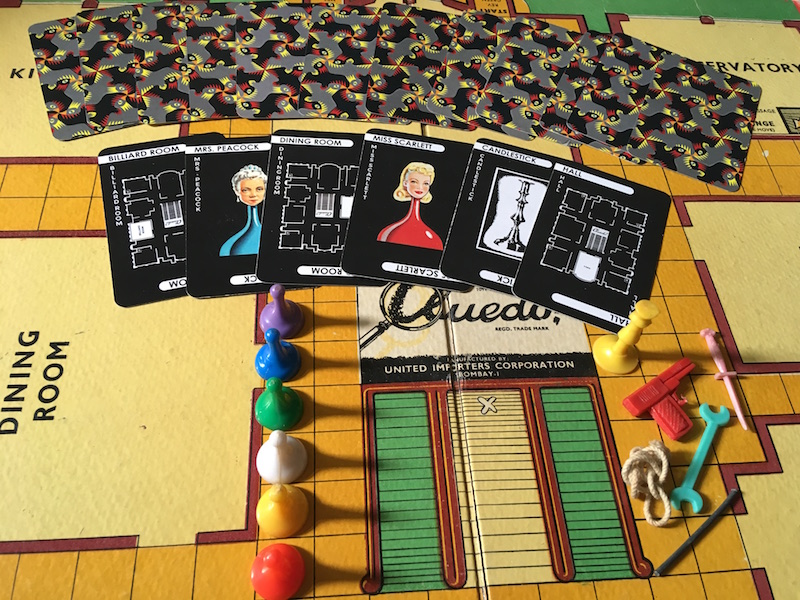
Protoypes in classic Cluedo – people, equipment and locales

Cluedo is a ‘country house murder’ game and was itself based on ‘country house murder mystery weekends,’ which were in turn based on the typical conventions (templates and prototypes) developed in the ‘murder mystery novel,’ (works such as Agatha Christie’s The Body In The Library, 1942). We can see, then, how Cluedo is an abstraction from an abstraction of a genre in which reality itself has been modelled in a highly stylised way. Cluedo takes the templates and protoypes of a genre, then, and stereotypes a stereotype based on them.

Cluedo‘s narrative templates are simple – one of the upper class guests in the ‘country house’ setting is always murdered by one of the others; the identity of that murderer has been concealed; and game unfolds using the classic ‘murder mystery’ narrative template of investigatoin and interrogation of suspect individuals by detectives, culminating in a summons of all the country house’s inhabitants to ‘the Library’ where the truth is to be revealed (a template drawn upon time after time in Agatha Christie murder mystery stories).

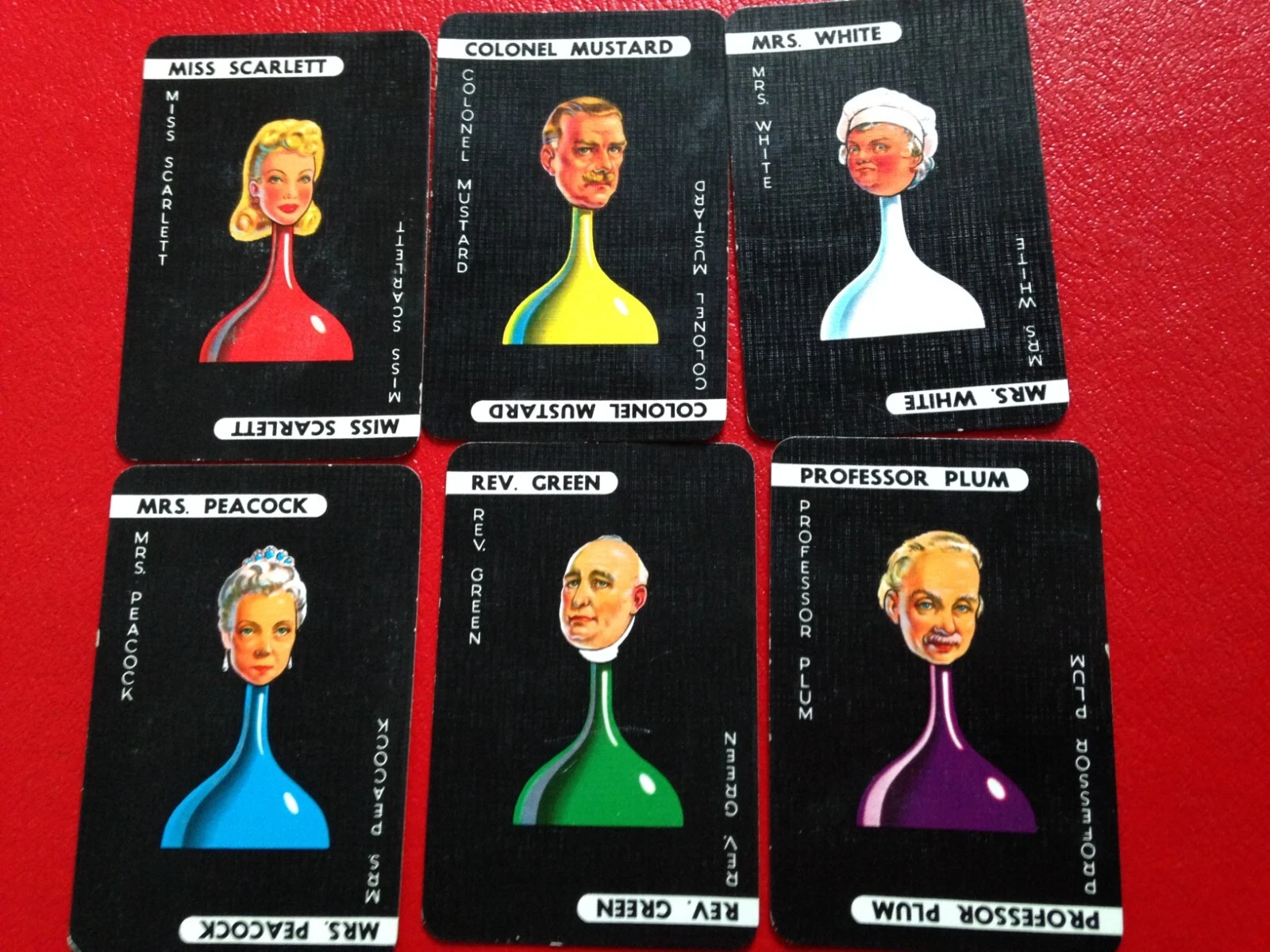
The prototypes in play in the game include prototypes for locale / mise en scène (country house, with dining room, ball room, library, etc.), artefacts (the lead piping, the rope, and other murder weapons), and pro/ant-agonists (Miss Scarlett, Professor Plumb, Colonel Mustard, etc).

Students as Active Meaning-makers

The constructivist account of story-comprehension as story-co-construction is one in which the story-consumer (viewer, listener, etc) is highly active. They make and revise hypotheses as they consume, drawing on available cultural resources (schemata) to make sense of data they are presented with on TV or cinema screen, through what they hear, through what they read, through the images they are presented with (and so on). These resources are learned, culture-specific and they change over time.

My hypothesis, in what follows, is that what is true of making sense of ‘fictional’ stories (Bordwell’s focus) is as true of making sense of ‘factual’ stories also, such as the stories we focus on in history lessons.

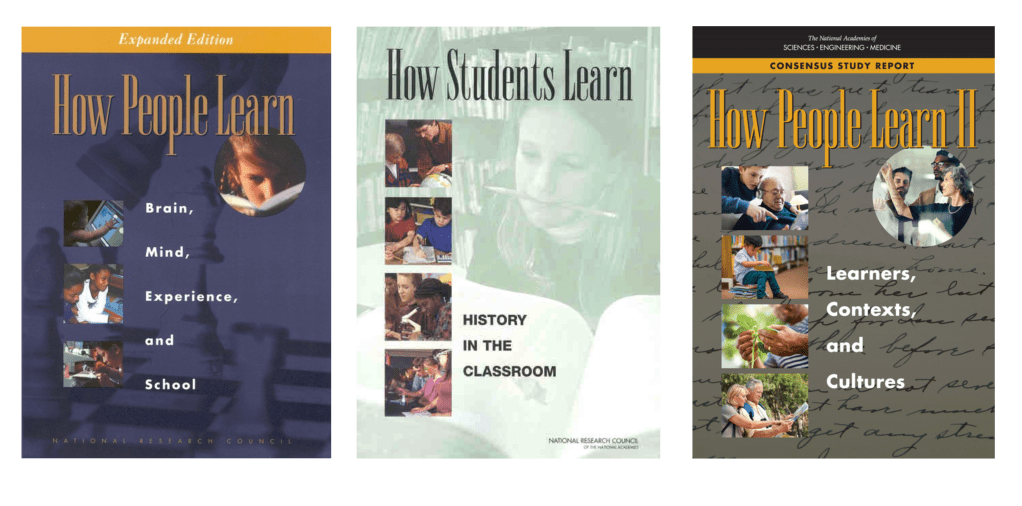
If we accept that premis then in follows that teachers need to attend to the cultural resources that students bring to the task of making sense of the stories we present them with in history. They will, as the How People Learn project showed more generally, bring their own assumptions to the task of story-construction and these will draw upon their own prior experience of the world and their experience of how stories about the world work.

Three fundamental open access books in learning theory – NAP, 2000, 2005 and 2018.

As all historians know, context is everything in history, and the worlds of the past differ from the worlds of the present in fundamental ways – which is one reason why, of course, the concept ‘anachronism’ is of such interest to history educators. Helping children make sense of stories about the past involves developing and expanding the prior resources they bring to the task of constructing meaning. It means building new prototypes (e.g., for the kinds of actors, beliefs and motivations that one might find in medieval contexts; e.g., for those one might find amongst the Victorian Middle Classes; e.g., those we might find amongst Aztec nobility and amongst Spanish Conquistadores). It means building new templates of how events can unfold (What happens in a revolution, and uprising, and so on?), including understandings of what narrative lines of development might look like in history, as opposed to other genres of story-making.

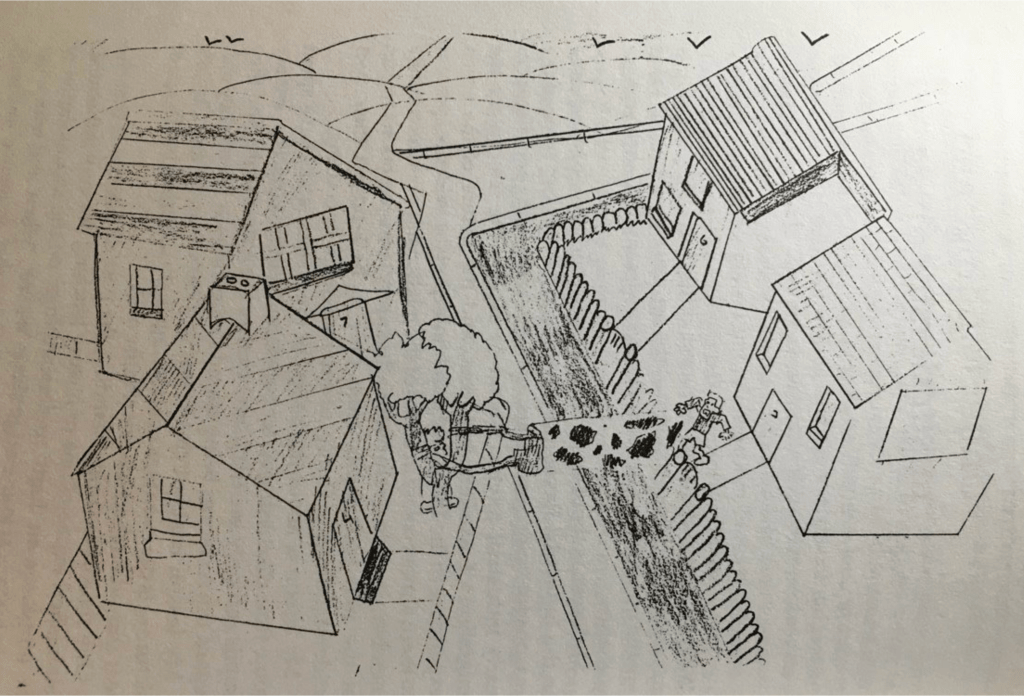
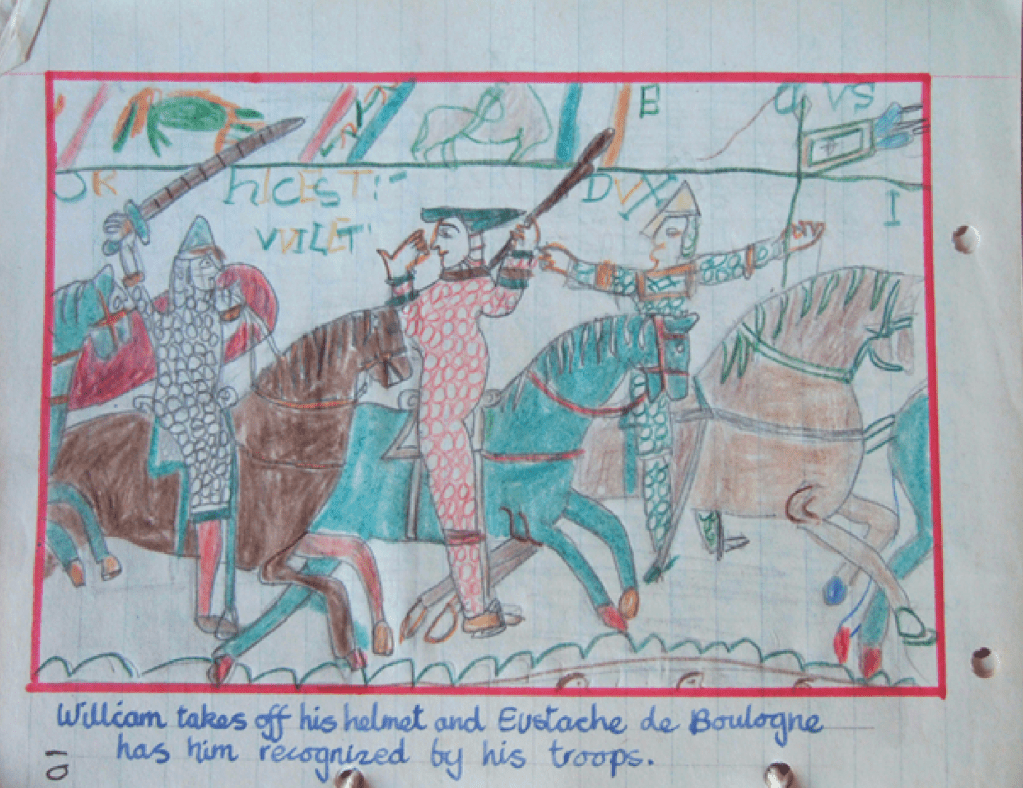
It is also likely to involve ‘clearing the ground’ and trying to help deconstruct misconceptions that students may have, such, for example, as the misconceptions of what 18th Century Paris looked like and of how terror operated that seem to be in play in the mind of the student who drew the following representation of the French Revolutionary Terror.

A school students’ drawing of the Terror, Chris Husbands (1996) What is History Teaching, p.75.

Narrative comprehension and text comprehension

We have become much more used than we ever were, in educational practice in the last 15 years or so, to cognitive science and cognitive scientific paradigms and research. I would no longer be told now, as I was about 15 years ago, to avoid using the word ‘cognitive’ in an article for a teacher magazine because it would put teachers off reading it. There are limitations. nevertheless, it seems to me, in how cogntive science has been appropriated, in England, and, also, in the use made of schema theory in history education literature.

Talk about schema and schemata has increased significantly in history education discourse in England since the early 2010s, however, it seems to me to be quite limited to understandings of specific substantive concepts and to draw on work on text-comprehension at the level of the sentence or paragraph. It also often draws quite heavily on a limited range of references (as I have noted above, Chapter 2 of Hirsch’s Cultural Literacy is often a key reference – we need more).

Understanding a story involves more than understanding a sentence or a paragraph and we need a wider repertoire of schema-types than is typically found in text comprehension work. Hence, it seems to me, the suggestiveness of Bordwell’s typology (prototype and template schemata), although differentiating a concept into to two subtypes is only a beginning and not an end.

Schema have also been discussed in the work of James Wertsch (see, for example, Wertsch 1998, 2002 and 2021), and in the work of researchers drawing on his example (for example, see Wertsch’s introduction and the related empirical papers in this open acces journal special edition on nations and narrations). Wertsch’s work couldn’t be more different from text-comprehension appropriation of schema-theory – it works at the very zoomed-out and large scale of the tools cultures use to make sense of themselves, and not at the micro-level of understanding X, Y or Z text.

Wertsch distinguishes between specific narratives and schematic narrative templates – the former are particular stories about specific events (e.g., the story of the evacuation of troops from the beaches of Dunkirk in late May and early June 1940) and the latter are large-scale interpretive stories that different cultures use (Wertcsh hypothesises) to construct large scale narratives about themselves and that they also use to help make sense of particular events that arise.

Much of Wertsch’s work on narrative templates works through data sets about narratives in the former Soviet Union and its former Eastern Bloc satelites. One of the conclusions that Wertsch draws is that Russian narrative identity, at a national level, is bound-up with, and expressed through, a ‘trimuph over alien forces’ narrative template, in which Mother Russia is invaded (without provocation and without good reason) by an external aggressor, and then almost defeated at great cost in life and treasure at the hands of this nefarious foe, before, finally and through great sacrifice, expelling the invader and restoring her former position. The point about such templates, Wertsh argues, is that they are identity-stabilising large-scale stories that members of national cultures can reach for, effortlessly and without much thought, at moments of crisis, and use and re-use over time. Whether or not using any particular template would be a positive thing, overall, in terms of the actions and reactions a template might sanction, is, of course, another matter.

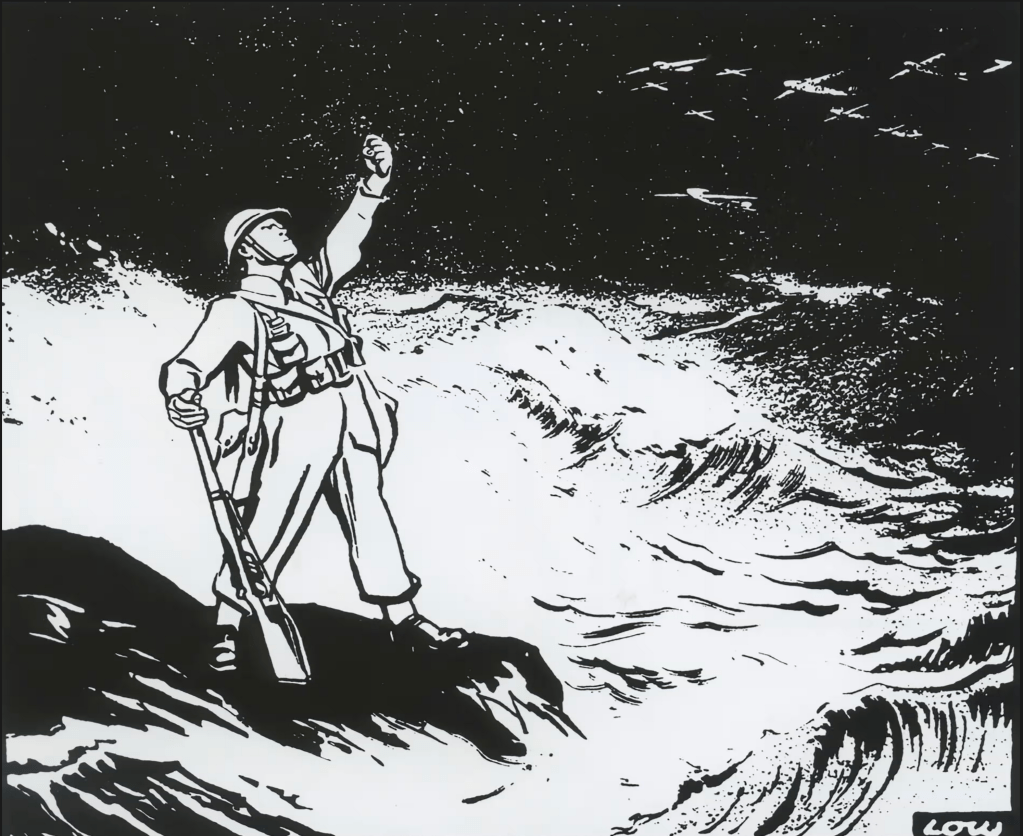
David Low, ‘Very Well, Alone,’ (1940) Pictorial Press/Alamy

An equivalent in Britain is captured in David Low’s famous cartoon (above) which, one might say, both encodes and deploys a story the British are fond of telling themselves about their resilience and their ability to muddle through and resist overwhelming odds through sheer grit – a schematic narrative template that is periodically refunctioned, for example, in the dramatic re-emergence of the ‘Keep Calm and Carry On’ poster.

This poster, now treated almost as a pure embodiment and expression of the ‘Blitz Spirit,’ was created in 1939 but shelved before use in 1940, and re-emerged around 2000, before becaming almost ubiquitous during the austerity years after 2010. A poster rejected in 1939/40, then, became a cultural archetype of the spirit of 1940, and a way of reasserting another questionable narrative – Britain was not alone in 1940, she had ‘her’ Empire with her. A questionable narrative that might, at times, do as much harm as good.

A useful project, it seems to me, might be to take Bordwell’s typology (prototypes and templates) and to seek to differentiate it further, thus generating a model of the range of schemata and resources that we might aim to try and develop in our students to help them make sense of the stories about the past that we want them to be able to master, understand, and use.

It seems to me, also, that Wertsch’s work might be useful in this endeavour. I find the notion of culture-wide shared narratives a little dizzying (‘How might we know what they are and that they exist (if they do)?’ is one question, and there are others). It seems sensible to explore what Philpott called ‘meso-level’ uses of Wertsch’s ideas (1), however, and to explore the possibility that culturally constructed conventionalised narrative schemata exist and work at varying levels of complexity, forming a spectrum between micro-stories (such as the Dunkirk story about little boats) and Wertch’s macro-level templates.

From Prototypes to Stereotypes: Affordances and Constraints

Cluedo is a highly limited representation of the world – and one that, one imagines, no one takes seriously. Arguably, however, we should take world-building representations, in all their forms, very seriously, as they all contribute to the overall task of making our life-worlds and delineating their possibilities and exclusions, to one degree or another. All stories matter, on this understanding, in the sense that they all contribute, even if only in a very small way in an individual case, to consituting world-pictures, social norms and paradigms, and, thus, to shaping and delimiting future possibilities – an awareness that has underwritten much contestation in cultural politics in the last fifty years.

The history of the worlds represented in Cluedo over time demonstrates this. The world represented in the original Cluedo, was prototypically White and prototypically patriarchal: all the characters in the game play were White and whereas all the male characters were identified by their roles in society (Colonel Mustard, Professor Plumb, Reverend Green) two of the three female characters were identified solely by their marital status (Mrs Peacock, Miss Scarlet). The 2023 edition of Clue, by contrast, features an African-American Miss Scarlett and an an African-American Professor Plumb, and although Miss Scarlett is sexualised in appearance (the ‘scarlet woman’ stereotype persists, perhaps one might say) the game notes tell us she’s in fact a ‘sharply intelligent investigative journalist’ masquerading as a ‘socialite.’ Furthermore, the remaining two female characters are now identified by their role (Mrs Peacock becoming Solicitor Peacock, and Mrs White, always visually a chef, being renamed to become Chef White). Despite these changes the game continues to have a social bias. It is still largely about the rich and powerful and, although from the perspective of Brecht’s Worker it improves upon high political history by including a cook – a fact that acknowledges pointing the existence of a workers enabling all this ‘luxury’ – there is no possibility in the game play for the largely invisible working classes to organise and contest the inequalities that the game’s mise en scène simply takes for granted.

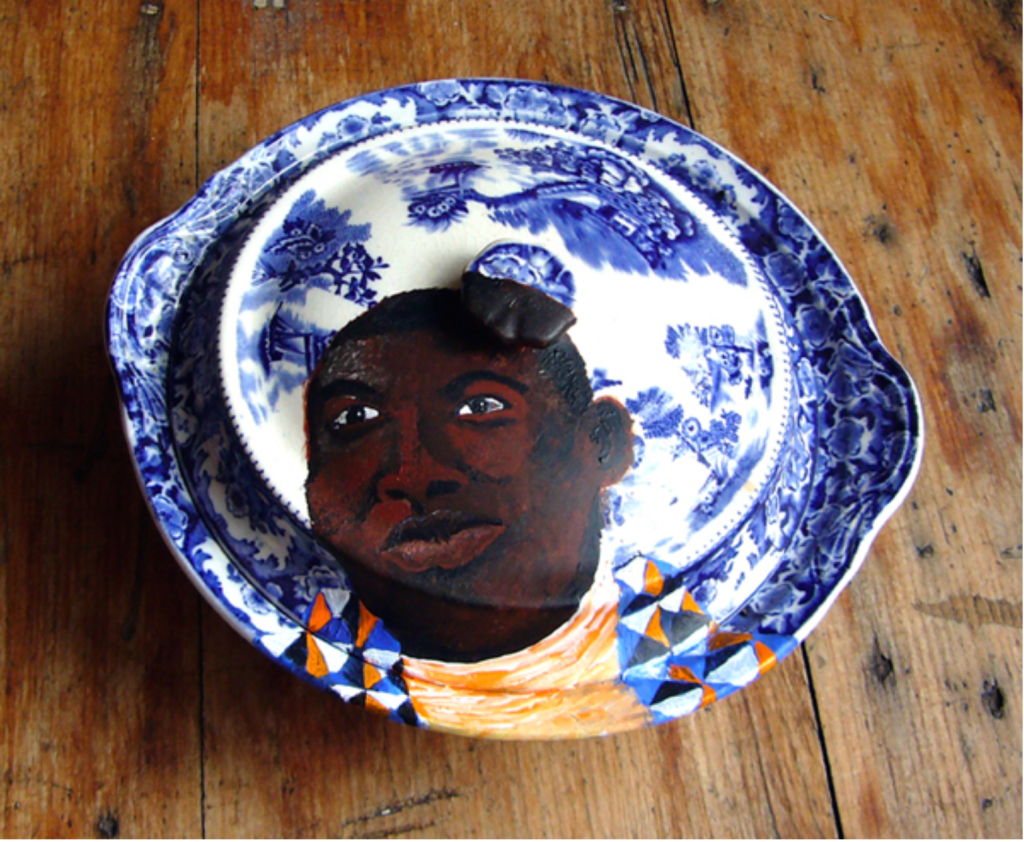
Lubaina Himid’s Swallow Hard: The Lancaster Dinner Service – detail (2007)

World representations like Cluedo matter, perhaps, in a number of other ways, also, not least by pointing to historical processes that have contributed to the shaping of ideas of taste, wealth and status in the United Kingdom, and more broadly, to cultivating a romanticised Downton Abbey paradigm of Englishness.

In addition to being a culturally available prototype, the ‘country house’ is also a historical symbol or synecdoche of a much larger and much more brutal history. As critics of the ‘Jane Austen’ world of Regency ‘elegance’ have frequently pointed out, and as projects like Corinne Fowler’s Colonial Countryside Project have shown, the wealth that built these expressions of power and conspicuous consumption, and that enabled this ‘elegance,’ had its roots in enslavement, empire and other forms of imperial extraction and exploitation. A fact that is very dramatically apparent, for example, in cases like Powys Castle and Harewood House.

Do the world-representations provided in history classes present a limited picture of past worlds and help to perpetuate notions of status and power created in deeply unequal class-, gender- and race-divided societies? Do we, alternatively, develop rounded pictures of past realities that explore the dynamics of how those social, cultural, economic and political formations worked, for example, to create, control and selectively distribute wealth, status, power and life-chances? Are the prototypical images of actors in the past that we present ones that say that only upper class men had agency and could shape their worlds, or do the stories we tell and co-construct in class show, alternatively, the ways in which the actions and counter-actions of all members of past societies came, in interaction with each other, to shape and reshape past worlds, and to help to create our worlds?

Do do the protypes of past actors, states of affairs and processes that history education helps to build sanitise the past – like the sheen on well-polished Gillow furniture that osbcures any connections with enslaved mahogany loggers and processors? Or, like Lubaina Himid’s Lancaster Dinner Serivce, commissioned for the bicentenary of the Abolition of the Slave Trade, do our history lessons give voice to and make present both past systems of power and exploitation and the agency of those who challenged the inequalities underpinning them?

Narrative Ethics and Historical Relevance

School work of John Hite, 1964-5, History in Education Project Archive, IHR.

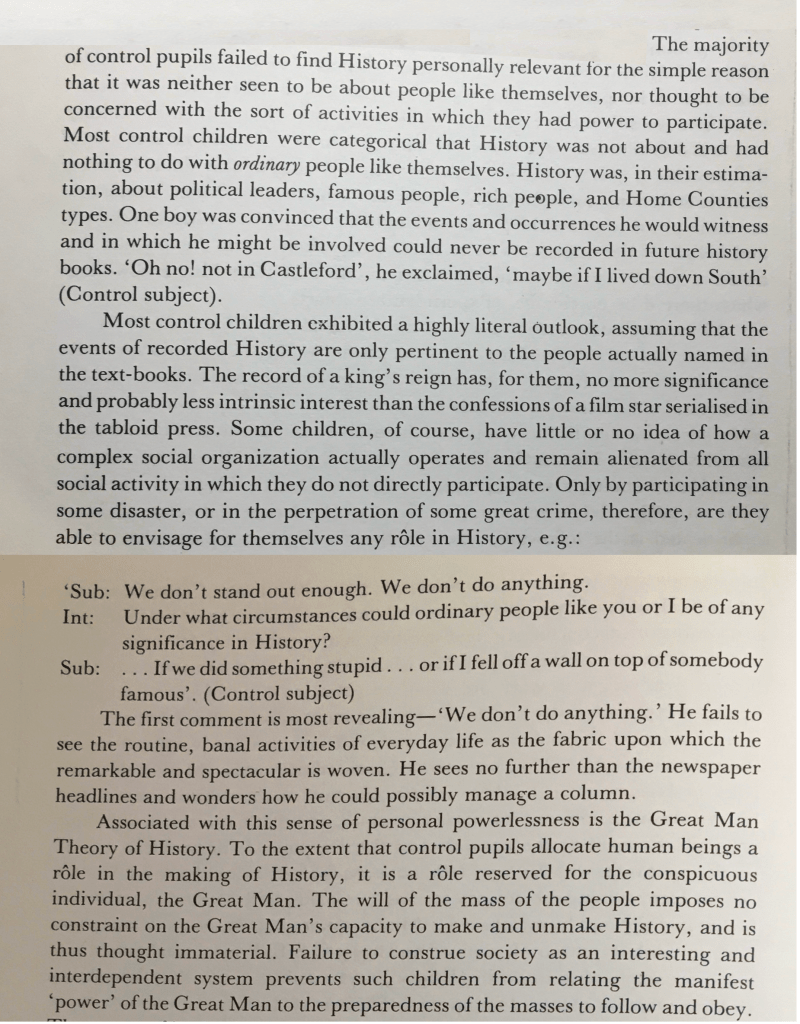
The importance of these questions, and the differences that narratively inclusive history teaching can make, are pointed to by some largely-undiscussed findings of one of the most significant history education research studies conducted in the twentieth century – Denis Shemilt’s evaluation study of the Schools Council History13-16, itself one of the most important curriculum development projects that we have seen in history education to date.

Shemilt’s study compared outcomes for children taught conventional political history (the ‘control pupils’) and for children taught history in the innovative manner developed by the SCHP (now the SHP), a project with innovative pedagogy that also aimed to change the content-focus of school history so that it foregrounded ‘ordinary people,’ and social and economic history.

Although Shemilt was too careful a researcher to overclaim and only present positive findings about the differences between ‘control’ and ‘Project pupils,’ he nevertheless reported some highly suggestive differences in attitudes towards history and in the sense of personal agency expressed by pupils in the two groups.

On the one, hand, ‘most History 13-16 candidates’ found ‘the subject personally relevant… because they see it as dealing with people like themselves (Shemilt, 1980: p.23). On the other hand:

Shemilt, D. (1980) History 13-16 Evaluation Study, Edinburgh: Holmes McDougall, pp.21-22.

A narrative-ethical question that arises from these considerations, I think, is the following: ‘Does our history curriculum develop prototypes of past actors that help students feel empowered and see their everday lives – and the lives of ordinary people in the past – as ‘the fabric upon which the remarkable and spectacular’ can be ‘woven?’ Altneratively, does it create a vision of the world (past and future) in which only powerful minorities have agency and in which only powerful minorities have a world to make and shape?’

Shemilt’s findings suggest that attending to these matters can have significant impacts on learners and on the prototypes and world-models their history lessons can help them build.

Conclusion

This post has tried to show that the notion of prototype schemata might have some value in helping history educators think critically about inclusivity and the implications of their curriculum choices, and of the narratives that they tell, for children’s sense of agency and self.

It has also, I hope, prepated the ground for reflection of the possible value for history educators of Kurt Vonnegut’s work on story templates, or what he calls the ‘shape of stories.’

*****

Endnotes

(1) I would like to dedicate my work on narrative ethics to the memory of Professor Carey Philpott who died suddently and much too young in January 2017. We had started to do some work together on narrative in educational policy in the run up to the BERA conference that September in Leeds and it is a matter of great regret to me that we could not continue that work together for many more years.

Getting the Story Right and Telling the Right Kinds of Story: Narrative Ethics, Part One

What is narrative ethics?

History education should pay more attention than it currently does to what I am going to call ‘narrative ethics.’

Narrative ethics relates to practical and empirical questions about the positive and negative effects that stories can have on their audiences, and opens-up ethical questions about the kinds of story that we should and should not tell, and that we should and should not credit, promote, share, and so on.

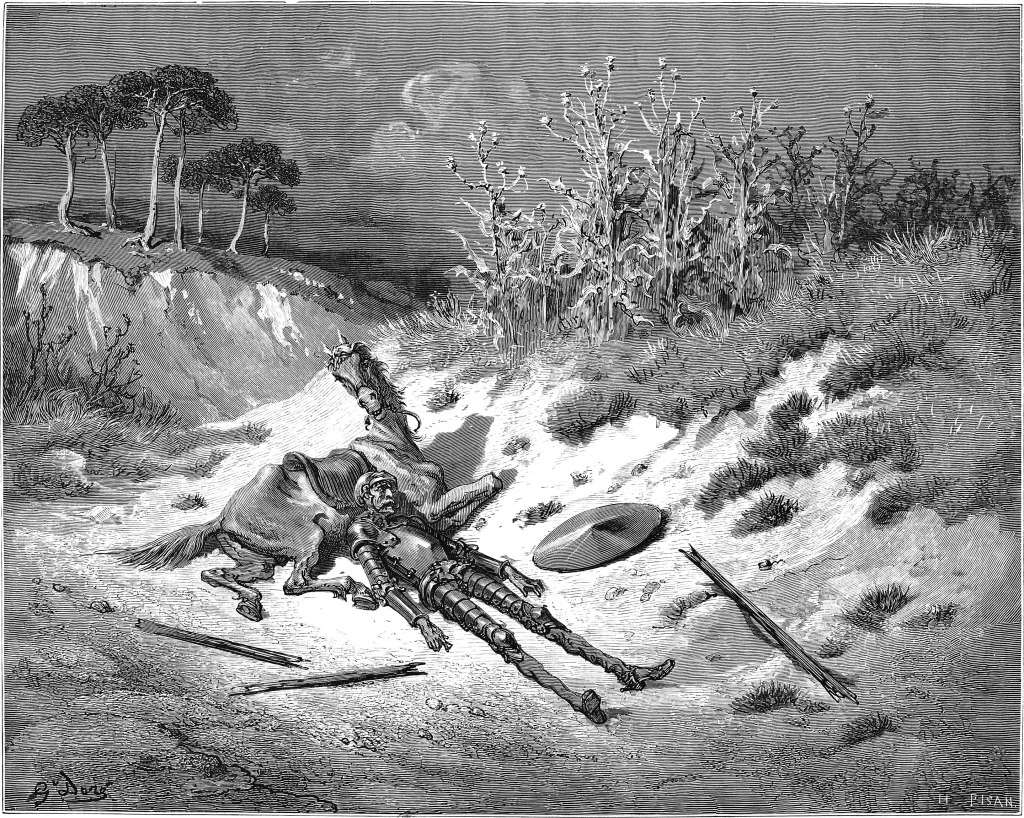
Stories are both enabling and dangerous things – tilting at windmills is, no doubt, an enjoyable pass time, even if it is a futile one. Both Madam Bovary and Don Quixote‘s (fictional) lives suffer as a result of the kinds of stories they lived and told themselves. We should care about the kinds of story that circulate around us, then, about the kinds of story that inform our actions, and the kind of tales we tell ourselves about who we (and others) are and can be.

The pedagogic aim of narrative ethics should be first, to practice responsible story-telling in history classes as teachers – and, by transfer, in other contexts; and, second, to nurture students’ narrative responsibility, their disposition to tell responsible stories and their aversion towards irresponsible stories and irresponsible story-tellers.

Narratve ethics is a topic that I have written about before – without explicitly calling it that – for example here in Public History Weekly, reflecting on the work of Tzvetan Todorov, and, in a sense, it lies at the heart of all history education, since history concerns itself with the question ‘What can we reasonably claim, say and believe about the past?’ I have written about narrative ethics here, also – again with calling it that – reflecting on irresponsible stories told about history education.

My thinking on this topic has been influenced – as have so many other aspects of my thinking about history – by the work of Peter Lee, in particular, by his emphasis on the importance of developing ‘dispositions’ in history and not just knowledge and understanding (see Lee’s chapters here and here, for example). Learning a discipline is learning a practice and a way of going about things, and narrative responsibility should be one of the historical virtues.

Getting the story right – more than the sum of its parts

Traditionally, history education might have regarded narrative responsibility as an epistemic question, concerned with the truth of claims. That’s a reasonable way of approaching questions of credibility, clearly – minimally, a credible story is a story made up of credible claims. However, there is more to narratives that the sum or their parts – stories have form as well as content and thinking responsibily about stories means thinking about both these dimensions of narrative. This is one of the key insights of the so called ‘narrative turn’ in historical theory – a point made, for example, in Frank Ankersmit’s Narrative Logic, or in the various works of Hayden White, not least Metahistory and The Content of the Form. I have developed that point in various places – for example, in my contribution (pp.121-143) to the open access book Teaching History to Face the World Today (2023, Peter Lang), in relation to the Brecht poem ‘Alles Wandelt Sich’ and the Hitler narrative discussed below.

Cicely Herbert’s translation of Bertold Brecht’s Alles Wandelt Sich (1948).

Brecht’s poem consists of four statements (such as ‘We plant trees for those born later’) that are presented twice in different orders, linked by varying connectives (‘but’ and ‘and’). What is highly instructive about this is that these changes of sequence and connection have profound semantic consequences. The meaning of the first stanza is entirely altered in the second, simply by changing the form of narration, and without altering the content of any of the component lines.

This meaning-transforming power of narrative – operating independently of the truth of a narrative’s internal contents, or propositions – is apparent also in the summary narrative about Hitler that Lee produced in the open access book How Students Learn: History in the Classroom (at page 59), in which the overall narrative is created that is a transparent distortion of history, even though, in some sense at least, every single one of the propositions that make up the narrative might be considered ‘true.’

Telling the right kinds of story

Every page a victory. 
Who cooked the feast for the victors ? 

Every 10 years a great man. 
Who paid the bill ? 

So many reports.  

So many questions.

Bertold Brecht, Questions from a worker who reads, 1935 (extract)

The power of form to shape meaning is apparent, in different way, in another of Brencht’s poems – ‘Questions from A Worker Who Reads.’

Brecht’s ‘Worker’ reads convential history – the kind of ‘history from above’ that much historical writing has practiced since the disicipline was formalised in the nineteenth century under the flag of the nationalist state. And he reads that genre of history with an informed and sceptical gaze. The Worker knows that the kind of world-model he is being offered in these history-from-above great-man histories is at best partial and certainly implausible. It is a world structured by the actions of leaders who seem to be able to do everything by themselves – since only their agency is foregrounded in this genre of history-making. They ‘did’ it – without cooks, without armies, without stone masons, and, in short, without the working class. This is the kind of story that a worker is highly likely to want to question, particularly if supported by the traditions of critique and world-understanding nurtured by the labour movement.

The worlds of history – and the kinds of worlds that histories offer us – have broadened immensly since the 1930s. History from below, of the kind practised, for example, by E.P.Thompson, has served to ‘rescue’ many of the dramatis personae of the past hidden from history by the elite-focused gaze of high-political and ‘great man’ history that Brecht’s Worker reacts against. And so, of course, have other historiographic developments – the rise, for example, of social history, of women’s history, of Queer history, of post-colonial history, of Indigenous histories, and so on. These ‘varieties of history’ should, naturally enough, be central to history education, since history education is about understanding the multiple ways in wich sense can be made with and about the past.

This consideration adds awareness of, and the ability to distinguish between and compare, different types of history in various ways, including in terms of their relative strengths and limitations, to the goals that narratively informed history education might set itself. There is much more to narrative difference that simple sequence. And these differences have ethical consequences, since generic differences in types of history have consequences for who history sees and who history misses, and for who gets ‘hidden from history‘ and for whose pasts are ‘silenced.’

Toxic Narrative

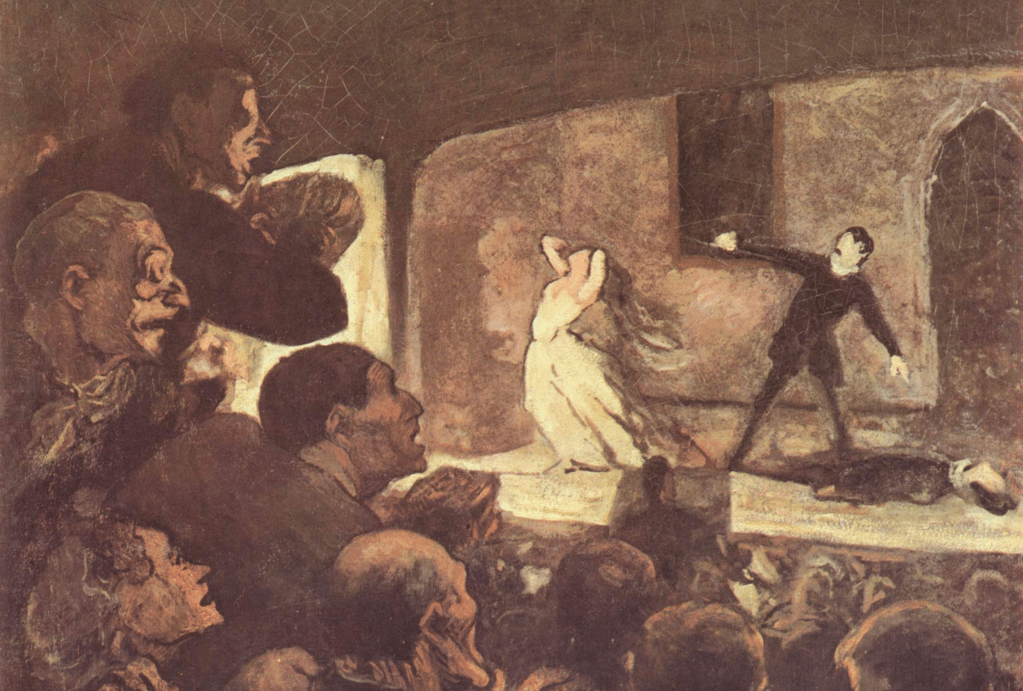
Honoré Daumier, Mélodrame 1855-60 (detail)

Questions of narrative ethics have increasing urgency, it seems to me, in our contemporary present – a world increasingly structured, it would seem, by polemical and simplistic melodramatic stories whose form is problematic and whose effects can be highly dangerous, as we saw on the 6th January 2021 in Washington and as we are seeing, again, in England and Northern Ireland at the time of writing, in late July and early August 2024.

Conspiracy theories – better called fantasies than theories – typically have very simplistic plots. They feature malign and hidden agents whose covert intentional actions are held to be responsible for negative features of the world, and, in particular, for damage to the lives of ‘good’ people, with whom the narrators of such stories identify. Their melodramatic character emerges as soon as we describe them. They pitch unequivocally ‘good’ and unequivolcally ‘bad’ characters against each other (as if the world were normally that simple, binary and two-dimensional), operating an ‘us’ and ‘them’ ontology. Such stories are manichean and implausible and toxic to democracy by that fact alone, as Todorov has argued, since they categorise and selectively other groups of our fellow-citizens.

Conspiracy fantasies are also ignorant of one of the most basic insights that one learns from the human sciences (including, of course, history) – namely that most developments in human affairs are the unintended consequences of the interaction of numerous actors operating independently, few, if any, of whom may have intended the actucal consequences that obtain at any particular time. The world of conspiracy fantasy is a much simpler and more satisfying one. A world in which things happen because some identifialbe and blameable group or person wanted them that way. It is a world that has the shape of a simple personal story – a shape that the real interpersonal and social world rarely actually has. It is an illusory – if satisfying – world in which someone (and never, of course, ‘us’) is to blame.

Simple stories work for many reasons and, not least, because they key into quite basic aspects of human psychology – as researchers like Matthew Williams have argued. ‘Us’ / ‘them’ dynamics are central to human sociality – ‘we’ have typically lived in groups throughout human evolution, and defending our in-group against threats works with the grain of that history. This is one reason why simplistic binarizing stories are so dangerous: when we are living a simple binary story, we can easily be triggered into violent actions, through narrative twists that turn the ‘them’ we identify against into a threat to the ‘we’ that we identify with. If ‘we’ become convinced that there is a ‘they’ out there who are hostile to us and responsible for our real or perceived misfortunes, and if we start to believe that ‘they’ really are coming for us and our families, then all kinds of aggressive action can come to seem both reasonable and necessary.

Narrative ethics involves, in at least part, attending to our narrative vulnerabilities – and becoming aware of ways in which they can be triggered and exploited. Reality is always multifaceted and never structured into clear ‘sides’ and neat binaries. We all contain multitudes and have hybrid identities, a fact that makes the notion of a simple group that we might identify with, and another we might identify against, a fairly absurd proposition.

There are, no doubt, historians who promote conspiracy theories – historians are human beings and binary thinking and threat reactions are part of our natural-historical inheritance. Nevertheless, I’m persuaded – and given some hope – by the argument that Raphael Samuel developed in The Enemy Within, his book on the 1984/5 Miners Strike, that historians are likely to be more ‘resistant’ to ‘conspiracy theories’ than non-historians (1984, p.13), a claim that points to the potential power and benefit of history education.

The notion that this strike was the work of ‘the enemy within’ that the then British Prime Minister Margaret Thatcher propagated, was, as Samuel noted, both implausible and a conspiracist trope. It was part of a melodramatic self-serving story that pitched nefarious ‘union barons’ against a virtuous ‘Iron Lady.’ We might also add that it was a profoundly undemocratic story – a metaphor that turned an organised group of citizens in dispute with the government, into an ‘enemy’ of the state that could legitimately be violently ‘attacked’ – as, of course, miners were at Orgreave and elsewhere.

It seems to me that Samuel’s response embodies the kinds of democracy-enhancing wisdom that one hopes a history education might aim to develop more widely.

“Historians… will know that leaders… are not so much causes as effects… They will know that decision-making is not an event but a process in which a thousand different circumstances conspire. And they may remember – if they are readers of Tolstoy, or students of the First World War – that in a battle nobody is less in command than the generals… A strike is not a controllable process but a huge wave of happenings… Even when a strike appears to be directed from above, its energies come from below….”

Raphael samuel, the enemy within, Pit Villages and the Miners’ Strike of 1984-5, 117-119

Conclusion

What the observations above point to, I think, is the conclusion that we must attend to how stories are told and structured, as much to the truth of the ‘facts’ contained in them, if we want to make an overall call on story-credibility. However important facts are – and they clearly are important – they are emphatically not ‘the whole story,’ as it were.

Some kinds of story are incredible simply because of the way they are told and simply because of the kind of story that they are. Other kinds of history are profoundly limiting and limited in the kinds of human experience they include and exclude and in the groups whose experiences they attend to and/or exclude.

As Samuel’s observations about conspiracy fantasies, above, indicate, there’s much more to assessing the credibility of history-stories than simply attending to sequencing and order. Form includes a range of considerations – including plot types, agent types, forms of causality, and much else. Form also includes attention to the types of history being told – histories that focus on ‘leaders’ only, for example, presume as much as they explain and exclude as much as they account for – just as masculinist stories, Eurocentric stories, and other limiting types of narrative do.

Learning what kinds of story one might find credible, or at least be disposed towards and in favour of simply because of their form is, it seems to me, part of what learning history means. ‘Facts’ matter but checking story-credibility involves so much more than ‘the facts’ and ‘checking’ the facts. Noticing and evaluating the form, the telling, and the form of the telling of a story matter just as much as thinking about claims and truths, where evaluating story-credibility is concerned.

And, of course, one can only care about questions like this if one has come to the narrative-ethical insight that stories and story-telling matter – that stories can legitimate and enable injustice and, also, of course, that stories can help to challenge injustice and change the world, and that there are kinds of story we should not tell, attend to, or help to share and spread.

Coda

This is the first of a series of posts. There will be at least three – ‘if the accident will’ (to borrow a line from Slaughterhouse 5). The two that follow will pursue the questions of narrative ethics in dialogue with the work of Kurt Vonnegut, a great story-teller and reflector on the good and the bad that stories can do. I will focus, in particular, on Vonnegut’s writing about the bobming of Dresden – work that points, I think, to both the power of focusing on narrative when evaluating stories about the past, and also, despite Vonnegut’s best efforts, to the limitations of a solely narrative approach.

Last edited: 25 January 2025