Introduction
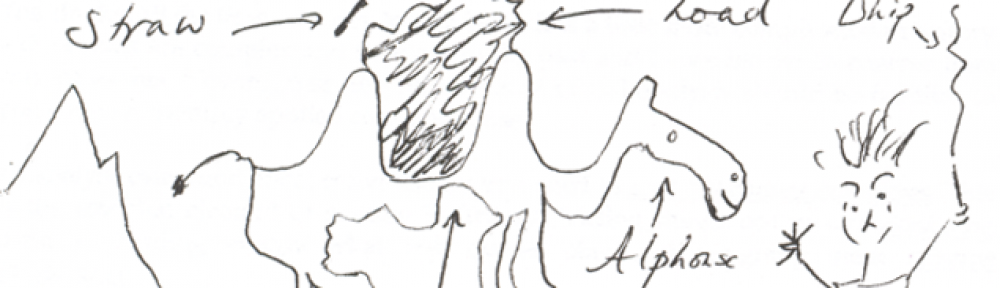
This page lists publications that I am aware of that relate to or draw upon the ‘Alphonse the Camel’ teaching strategy, developed to support and sophisticate students’ causal reasoning. Like everything else on this blog, it is work in progress. If you have suggestions for improvement, please don’t hesitate to get in touch.
My Work on Causal Reasoning: Alphonse the Camel
This is the article in which I first explained the Alphonse story, developed when I was Head of History at Esher College, Surrey, in 2001/2:
- Chapman, A. (2003) Camels, diamonds and counterfactuals : A model for teaching causal reasoning, Teaching History, 112, pp. 46-53. [Please visit the Historical Association’s website for more information on this publication and the journal Teaching History.]
A video, animating the original ‘camel story’ narrated in that 2003 article was produced in 2018 and can be accessed on this blog’s home page.
In 2013 I was invited to give a keynote address at the University of Barcelona on aspects of history teaching in England – as it was coming up for the tenth anniversary of the Alphonse article, I decided to use the opportunity to think about the story and its evolution through collaboration in history education communities of practice since it had been published. The paper was published in 2015 and again in a revised form, with additions referencing work in the Netherlands that made use of the Alphonse story, in 2016:
- Chapman, A. (2016) Developing Historical and Metahistorical Thinking in History Classrooms: Some Reflections on Research and Practice, HSSE Online, 5(2).
In 2017, I published a chapter on causal reasoning in history in Debates in History Teaching. The chapter is about historical explanation in general and not just about causal explanation. It situates the Alphonse strategy in a wider context. You can access a pre-publication proof of the chapter below:
- Chapman, A. (2017) Causal Explanation. In Ian Davies (ed.) Debates in History Teaching, London and New York: Routledge, pp. 130-143.
The Alphonse story has been translated a number of times over the years, for example in:
- Chapman, A. (2015) 推論為什麼:協助中學生理解歷史解釋的策略, National Taiwan Normal University, 23rd May; and
- Chapman, A. (2018) Camelos, diamantes e contrafactuais: um modelo para ensinar raciocínio causal. In Arthur Chapman Desenvolvendo o Pensamento Histórico: Abordagens conceituais e estratégias didáticas, Curitiba: WA Editores Ltda, pp.168-186, Tradução Lucas Pydd Nechi. Revisão por Marília Gago.
Developing the Alphonse Story and Approach
A number of people have made use of, enhanced or developed the ‘Alphonse’ story in various ways over the years – either by adding to the story or by rewriting it. It’s been great to know that it’s been useful and really interesting to see how others have developed the approach!
In 2005, James Woodcock published a revised and enhanced version of the story in Teaching History and a briefer article on this work in the TES. Woodcock extended the story, adding layers of complexity:
- Woodcock, J. (2005) Does the linguistic release the conceptual: Helping Year 10 to improve their casual reasoning, Teaching History, 119, 5-14.
In 2006, James Woodcock and I ran a workshop together about using the Alphonse story in history at the Schools’ History Project annual conference in Leeds, where a Teachers TV producer began talking to us about commissioning two programmes about it. These were recorded at Cottenham Village College, near Cambridge, in January 2007. The first programme focuses on the Alphonse story and its rationale and the second is about transferring learning from the analysis of the fictional story (‘Was it really the straw that broke the camel’s back?’) to causal reasoning about World War I (‘Did two bullets really cause 20 million deaths?’):
- Teachers’ TV (2007) Gifted and Talented – History, Causal Reasoning; and
- Teachers’ TV (2007) Gifted and talented – History, Causal Reasoning World War I.
Ellen Buxton ‘created Louis, the ill-fated royal camel whose death requires explanation‘ (2010, p.4), drawing on the Alphonse story, in an enquiry sequence exploring differing historical outcomes in Britian and France in the eighteenth century, recontextualising the fiction in the real past:
- Buxton, E. (2010). Fog over channel continent accessible? Year 8 use counterfactual reasoning to explore place and social upheaval in eighteenth-century France and Britain, Teaching History,140, 4-15.
Drawing inspiration from Woodcock’s retelling of the ‘Alphonse’ story, Scott Waring produced an extended narrtative of ‘Cam the Camel’ who joins a traveling circus and falls into the clutches of a sadistic camel trainer, ‘Mack the Camel Slayer’:
- Waring, S. M. (2010). Escaping Myopia: Teaching Students about Historical Causality, The History Teacher, 43 (2), 283-288
The Alphonse story has been re-used and developed in many other ways – not all of which I’m aware of. It has been used, for example, by New York City Department of Education in its Social Studies curriculum materials, in the Big History Project and by the Open Educational Resources (OER) Project in their student materails. Here are some related links:
- Tomlinson, B. (2017) Tackling Causality, BHP Teacher Blog, June 29th 2017;
- Big History Project (2019) Lesson 6.2 Activity: Causation – Alphonse the Camel; and
- OER Project (n.d.) World History Project Lesson Materials: Causation – Alphonse the Camel.
My work on causal reasoning – and Woodcock’s work – both figure centrally in the discussion of causation in Ofsted’s discussion of causation in their July 2021 Research Review on History.
I am really interested in hearing more and in including further examples of published uses and reworkings on the ‘Alphonse’ approach. Please do let me know what I’m missing in the list above and I’ll update it (thecamelsbackorg@googlemail.com).
Research on Alphonse the Camel
Gerhard Stoel‘s doctoral research at the University of Amsterdam on developing causal reasoning included an exploration of the effects of the explicit teaching of historical reasoning, including the ‘Alphonse’ story as one element of an intervention design. This aspect of the research is reported here:
- Stoel, G. L., van Drie, J. P., & van Boxtel, C. A. M. (2015). Teaching towards historical expertise: developing a pedagogy for fostering causal reasoning in history, Journal of Curriculum Studies,47(1), 49-76.
Noel Ong, in Singapore, has reported positive findings associated with the use of the ‘Alphonse’ strategy:
- Ong, N.P. (2018) Rethinking the Approach to Teaching Causation in the History Classroom, HSSE Online 7(2), 50–58.
Although it has been significantly interrupted and delayed by the pandemic, international collaborative research on the use of analogy in the Alphonse story is currently underway. I’ll be adding details on findings relating to this work here, when they are available.
Page last edited: 9th August 2024
 The Camel's Back